Chinese promotion of gold as an investment can only help to increase demand for relatively scarce Gold Panda Coins.
Author: Lawrence Williams
Posted: Thursday , 03 Sep 2009
LONDON - We are indebted again to Paul Mylchreest's Thunder Road Report for news that will bring big smiles to gold and silver investors everywhere. Apparently China is pushing the idea of buying gold and silver for investment purposes to the general population in the way that Western television sells soap powder. If 1.3 billion Chinese citizens start buying gold and silver, even in tiny quantities, imagine what that will do to the market!
The report notes that China's Central Television, the main state-owned television company, has run a news programme letting the public know how easy it is to buy precious metals as an investment. On silver investment the announcer is quoted as saying, "China has introduced its first ever investment opportunity for silver bullion. The bars are available in 500g, 1kg, 2kg and 5kg with a purity of 99.9%. Figures show that gold was fifty times more expensive than silver in 2007, but now that figure has reached over seventy times. Analysts say that silver has been undervalued in recent years. They add that the metal is the right investment for individual investors and could be a good way to cash in."
What appears to have happened in China is a total relaxation of strictures on holding precious metals by the individual with the government pushing gold and silver as an investment option, seemingly at every opportunity. This is a far cry from the situation only a few years ago where the distribution of gold and silver was strictly controlled. Now, the Thunder Road Report notes that every bank will sell gold and silver bullion bars in four different sizes to individuals and gold-related investments are said to be soaring in popularity.
Saturday, September 05, 2009


Hong Kong is pulling all its physical gold holdings from London
Recent news items suggest that China is making moves to reposition physical gold within its economic system.
HONG KONG (MarketWatch) -- Hong Kong is pulling all its physical gold holdings from depositories in London, transferring them to a high-security depository newly built at the city's airport, in a move that won praise from local traders Thursday.
The facility, industry professionals said, would support Hong Kong's emergence as a Swiss-style trading hub for bullion and would lessen London's status as a key settlement-and-storage center.
"Having a central government-sponsored vault would create a situation where you could conceivably look at Hong Kong as being a hub, where metal could be traded for the region," said Sunil Kashyap, managing director at Scotia Capital in Hong Kong, adding that the facility was the first with official government backing in the region.
The Hong Kong Monetary Authority, which functions as the territory's unofficial central bank, will transfer its gold reserves stored in other vaults to the depository later this year, the Hong Kong government said in an earlier statement.
HONG KONG (MarketWatch) -- Hong Kong is pulling all its physical gold holdings from depositories in London, transferring them to a high-security depository newly built at the city's airport, in a move that won praise from local traders Thursday.
The facility, industry professionals said, would support Hong Kong's emergence as a Swiss-style trading hub for bullion and would lessen London's status as a key settlement-and-storage center.
"Having a central government-sponsored vault would create a situation where you could conceivably look at Hong Kong as being a hub, where metal could be traded for the region," said Sunil Kashyap, managing director at Scotia Capital in Hong Kong, adding that the facility was the first with official government backing in the region.
The Hong Kong Monetary Authority, which functions as the territory's unofficial central bank, will transfer its gold reserves stored in other vaults to the depository later this year, the Hong Kong government said in an earlier statement.
Thursday, July 30, 2009
Chinese Gold Panda Proof Coins: Fact vs Hype
When browsing the web for modern gold coins, you will likely encounter sellers who proclaim their offerings to have qualities such as "Mint", "Brilliant", or "Proof". These terms are often thrown around improperly and can lead to a bit of confusion. Here are some clarifications with regard to the Chinese Panda coin series.
A "Mint", "Mint-state", or "MS" coin is simply a coin that is uncirculated and preserved in the condition it was in when it left the mint. This is no assurance that the coin is shiny and clean. Mint State coins may have been stored in bags with other coins where they received "bag-mark" scratches from other coins. An issuing mint may or may not have good quality controls, and dies can become worn and damaged. The standard coin grading scale reserves the grades MS60-MS70 for these coins. MS60 can be beat-up looking and MS70 is essentially perfection.
"Brilliant Uncirculated" or "BU" is a standard issue coin that is in Mint State. This is usually the mass-produced version of a coin. This term is often used to distinguish a coin from "Proof" versions of the same coin that may have been issued.
"Proof" coins are specially produced coins that are usually made with highly polished dies and struck multiple times. Quality control is generally higher and the coins are typically sold with collectors in mind. Contrary to many offerings on the web, a proof coin is not just a clean shiny example of a BU coin!
The Chinese Panda coins are very attractive coins which often have a mirror finish contrasted with frosted elements, however, the majority of the Pandas are not proofs. In fact, the Pandas are so nice looking, that most of the genuine proof issues have a "P" mark on the obverse to identify it as the proof version.

1986-P Proof
Among the 1oz Gold Pandas, the following are the only proofs issued:
| Date and P mark | Official Mintage Limit |
| 1986-P | 10,000 |
| 1987-P | 10,000 |
| 1988-P | 8,000 |
| 1989-P | 9,000 |
| 1990-P | 5,000 |
| 1991-P | 3,500 |
| 1992-P | 2,000 |
| 1995 | 2,000 |
| 1996 | 1,500 |
From 1986-1996 proof sets were issued. except for 1993 and 1994, these were 5-coin sets with a 1oz and fractionals 1/2, 1/4, 1/10, and 1/20 ounce. In 1993 and 1994, the largest coin in the set was a bimetallic gold-silver 50Y coin - no 1oz was issued.
1986-1992 the proof coins have the exact same design as the BU coin, except for the P mark on the Panda side of the proof versions. If there is no "P", its not a proof. In 1995 and 1996, the proof have a different design than the BU coins, making them easy to distiguish.
In addition to the 1oz and fractional proofs, there are jumbo size Pandas in 5oz, 12oz, and 1kg sizes that were issued as proofs in many years. I have not covered those here, but you can browse a good Chinese coin database at http://china-mint.info for more info.
So be advised that there are many mis-labelled, improperly advertised, and even incorrectly certified proof pandas. I have seen NGC certified PF proof Pandas from years in which proofs were not issued. PCGS has not made the same mistake to my knowledge.
The Panda proofs are especially attractive to collectors dues to their low mintages as well as their beauty. All of the proofs have mintages of 10,000 or less. With the 1996 being the rarest at only 1500 coins!
Thursday, April 16, 2009
2009 Panda Coin Mintage Limits Reached
The word from the coin dealer network is that 2009 mintage limits of the gold and silver pandas coins have been reached. Each year, China Gold Coin Inc (CGCI) designates a limit on how many Panda coins will be produced and sold for that mintage year. Due to the strong demand from the market, as of April 2009 those limits have been reached.
This means that no more 2009 Pandas will be coming into the market from CGCI. Dealer stock is the only remaining source, but as that is consumed, price premiums can be expected to rise.
Published 2009 Mintage Limits
1oz Gold: 160,000
1/2oz Gold: 60,000
1/4oz Gold: 60,000
1/10oz Gold: 100,000
1/20oz Gold: 100,000
1oz Silver: 600,000
This means that no more 2009 Pandas will be coming into the market from CGCI. Dealer stock is the only remaining source, but as that is consumed, price premiums can be expected to rise.
Published 2009 Mintage Limits
1oz Gold: 160,000
1/2oz Gold: 60,000
1/4oz Gold: 60,000
1/10oz Gold: 100,000
1/20oz Gold: 100,000
1oz Silver: 600,000
Thursday, August 28, 2008
1990's Gold Pandas - Low Mintage Sleepers
A recent comment raised a subject that I have been meaning to discuss for a while: I believe that the real surviving mintages for many of the Gold Panda coins of the 1990's is quite low.
The 1990's was a time of very low gold demand. Gold was declining in price and few collectors or investors were buying. Official mint sales limits were not met, and dealers could not sell the inventory of coins they had purchased.
Recent information published by the official Chinese Panda distributor has shown that the number of coins actually shipped by the mint at that time was much lower than what was officially published at the time. Ranging to as low as 4,000 coins for some issues.
I have heard from long time dealers that sales were so poor in those days, that many dealers were forced to liquidate thousands of unsold gold pandas by selling them to refiners to be melted down. It is unkown how many gold panda coins were lost. As one who watches the sales on ebay and other areas, I have observed that the mid-1990's Pandas are less common.
As investors and collectors worldwide move to gold and numismatics as a store of wealth against depreciating currencies, these coins are likely to emerge as unexpected rarities.
Have you got your 1990's Pandas?
Table of 1990s mintages click here
Wednesday, January 16, 2008
Bimetallic Pandas
There has been much attention lately to very low mintage pandas, with prices moving up rapidly. These would include the 1998 50Y Gold 1/2oz ($2500), the 1995 100Y Gold Proof ($6277), platinum pandas, and the 5oz, 12oz and kilogram Pandas. All of these have mintages less than 2500 peices, but a large and growing collector base whos number well exceed the mintage.
When there are more collectors than coins, prices move up. Typically, as the collector base grows, coins with populations near the supply/demand threshold will suddenly move up.
The bimetallic pandas represent a very attractive and collectible subset of the Panda series with very low mintages. Although already in short supply, prices have not yet reached the levels of the hot coins mentioned above. I believe the bimetallics will eventually meet and exceed these levels.
The bimetallic Pandas have a gold center with a silver outer ring, and are thinner than other pandas, but also wider in diameter, making them appear large for the bullion content. They were issued from 1990 through 1996, often in sets, with values from 10Y to 50
| Denomination | Gold | Silver |
|---|---|---|
| 10Y | 1/10oz | 1/28oz |
| 25Y | 1/4oz | 1/8oz |
| 50Y | 1/2oz | 1/5oz |
| 500Y | 5oz | 2oz |
In 1990 and 1991 bimetallic medals (no face value) were issued along with the coin and included in the mint set.
Official Mintage Limits:
| Year | Denom. | Mintage |
|---|---|---|
| 1990 | 50Y | 2000 |
| 1990 | 1/2oz+1/5oz | 2000 |
| 1991 | 25Y | 10000 |
| 1991 | 1/4oz+1/8oz | 2000 |
| 1992 | 10Y | 2000 |
| 1993 | 25Y | 2500 |
| 1994 | 10Y | 3000 |
| 1994 | 25Y | 2500 |
| 1995 | 10Y | 2000 |
| 1995 | 25Y | 2000 |
| 1995 | 50Y | 2000 |
| 1995 | 500Y | 199 |
| 1996 | 10Y | 8000 |
| 1996 | 25Y | 2500 |
| 1996 | 50Y | 2500 |
| 1996 | 500Y | 199 |
| 1997 | 10Y | 2800 |
| 1997 | 25Y | 2800 |
| 1997 | 50Y | 2800 |
| 1997 | 500Y | 199 |
Actual Mintages
The actual mintages of mid-1990s gold pandas has recently been acknowledged to be much lower than the published maximums. No actual figures have been published for the bimetallic, but given the time period, it seems certainly possible that actuals could be lower.
As a side note, based on apparent availability in the market today, the 1997 set seems to be more scarce despite its slightly higher official mintage figures.
The 10Y, 25Y, and 50Y were issued in 3-coins 1995, 1996, and 1997. The 1996 10Y was also issued separately, and this is reflected in the higher mintage figure.
Several Reference Pictures are shown below.
1995


1997


Tuesday, December 18, 2007
New Panda Coin Info Website
Pandacolletor.com is a new website dedicated to collecting Chinese Panda coins. It is not a promotional site, but rather a well researched informational site created by a dedicated collector.
I highly recommend this website for its original research into panda coin scarcity, including actual mintage figures and auction data, as well as its very complete set of coin images.
www.pandacollector.com
I highly recommend this website for its original research into panda coin scarcity, including actual mintage figures and auction data, as well as its very complete set of coin images.
www.pandacollector.com
Friday, December 14, 2007
China's wealthiest investors set for gold spree
This article from Reuters is quite interesting, but attracted almost no attention in the broader press.
China's wealthiest investors are on the brink of ploughing as much as $68 billion into gold markets as they take profits from roaring share prices and steer clear of property, a top fund manager and bullion bull says. Wang Weilie, a pale, bespectacled 40-something who manages over 1 billion yuan ($135 million) on the Shanghai Gold Exchange on behalf of himself and clients, says the so-called "Zhejiang clique" are ready to pounce after Beijing opens up spot market bullion trading and a futures contract launches early next year.
After amassing an estimated 3 trillion yuan ($400 billion) from investing in red-hot real estate and stock markets which have risen five-fold in the past two years, the wealthy group from eastern China is looking for the next sure bet. Wang says that's gold, and expects the amount of Chinese capital invested in the bullion market to soar 100-fold to some 500 billion yuan ($67.5 billion) in the next two years -- a sum that could catapult China ahead of India as the world's top buyer.
"We all agreed that upside room on stocks was limited, as was upside on property prices. But the gold price has only increased minimally, even after 20 years of China's reform and market opening," Wang told Reuters during a lunch with three business partners in Lujiazui, Shanghai's financial hub. Coupled with inflation and global economic uncertainty, the redirection of Chinese capital towards domestic gold contracts will help spot prices more than double, says Wang, who says he once cornered two-thirds of the Chinese gold forward contract. "Spot gold prices will hit $2,000 in coming years," he said. Wang expects more than 15 percent of the capital currently invested in China's stock market to move to gold trading. China's total market capitalization peaked at about 35 trillion yuan in October, exceeding the country's gross domestic product. The main stock index tumbled nearly 20 percent last month while Beijing has continued tightening controls over the property sector to limit price gains.
China's wealthiest investors are on the brink of ploughing as much as $68 billion into gold markets as they take profits from roaring share prices and steer clear of property, a top fund manager and bullion bull says. Wang Weilie, a pale, bespectacled 40-something who manages over 1 billion yuan ($135 million) on the Shanghai Gold Exchange on behalf of himself and clients, says the so-called "Zhejiang clique" are ready to pounce after Beijing opens up spot market bullion trading and a futures contract launches early next year.
After amassing an estimated 3 trillion yuan ($400 billion) from investing in red-hot real estate and stock markets which have risen five-fold in the past two years, the wealthy group from eastern China is looking for the next sure bet. Wang says that's gold, and expects the amount of Chinese capital invested in the bullion market to soar 100-fold to some 500 billion yuan ($67.5 billion) in the next two years -- a sum that could catapult China ahead of India as the world's top buyer.
"We all agreed that upside room on stocks was limited, as was upside on property prices. But the gold price has only increased minimally, even after 20 years of China's reform and market opening," Wang told Reuters during a lunch with three business partners in Lujiazui, Shanghai's financial hub. Coupled with inflation and global economic uncertainty, the redirection of Chinese capital towards domestic gold contracts will help spot prices more than double, says Wang, who says he once cornered two-thirds of the Chinese gold forward contract. "Spot gold prices will hit $2,000 in coming years," he said. Wang expects more than 15 percent of the capital currently invested in China's stock market to move to gold trading. China's total market capitalization peaked at about 35 trillion yuan in October, exceeding the country's gross domestic product. The main stock index tumbled nearly 20 percent last month while Beijing has continued tightening controls over the property sector to limit price gains.
Sunday, May 27, 2007
Rare Silver Proof Pandas on Fire
One of the greatest sleepers in the Panda series appears to be taking off. While most of the silver Pandas issued have had mintages in the 200,000+ range, there are several little known issues with mintages from 8000 to 25000 peices. These are the 1983-1985 BU silver coins and the 1989-1996 Silver Proofs.
Mintages:
1995 Obverse:
1996 Obverse:

The 1989-P through 1994-P issues have also started to rise, moving from $30-50 and approaching $75-$100+.
- 1983: 10,000
- 1984: 10,000
- 1985: 10,000
- 1989-P: 25,000
- 1990-P: 20,000
- 1991-P: 20,000
- 1992-P: 20,000
- 1993-P: 20,000
- 1994-P: 15,000
- 1995: 10,000
- 1996: 8,000
The 1983-1985 BU coins continue to increase in price steadily: currently in the $300-$500 Range when you can find them.
Since the BU silver Pandas often have a very proof-like finish, the proof versions have been often overlooked. In fact, the P mintmark may be all that distinguishes them in some years.
The 1995 and 1996 issues, however, have no P mark. The obverse panda design on the proofs is different from the BU coins. I have been amazed at the low prices of these rare coins, until recently. Over the last 8 months the prices have soared!

1995 Obverse:

1996 Obverse:
The 1989-P through 1994-P issues have also started to rise, moving from $30-50 and approaching $75-$100+.
Keep an eye on my Ebay store for rare silver and gold panda coins.
Sunday, April 29, 2007
PCGS vs NGC Grading: Apples and Oranges
NGC and PCGS grades are not the same. As shown in the graph below, for 1982 Pandas, PCGS clearly uses much tougher criteria than NGC.  NGC graded 44% of 82 Pandas as MS69, but PCGS only allowed 16% to reach that level. In fact, you have to add PCGS MS67 (12%), MS68(16%) and MS69(16%) to equal NGC's MS69 rate. One could conclude from this that a PCGS MS67 coin could be equated with an NGC MS69 for rarity.
Dealers have noticed this too. They have sent 3 times as many coins through NGC. Could it be because they know NGC will give a higher grade?
Collectors beware. If you care about accurate and meaningful grading, stick with PCGS.
 NGC graded 44% of 82 Pandas as MS69, but PCGS only allowed 16% to reach that level. In fact, you have to add PCGS MS67 (12%), MS68(16%) and MS69(16%) to equal NGC's MS69 rate. One could conclude from this that a PCGS MS67 coin could be equated with an NGC MS69 for rarity.
Dealers have noticed this too. They have sent 3 times as many coins through NGC. Could it be because they know NGC will give a higher grade?
Collectors beware. If you care about accurate and meaningful grading, stick with PCGS.
Monday, April 23, 2007
Why Invest in Chinese Panda Coins?
For decades, the Chinese government has minted the Panda coins and sold them primarily to foreigners. Chinese citizens either were not permitted to own, or could not afford gold and silver.
Today China's wealth is growing. Billions of inflated dollars and euros flow in daily to buy cheap manufactured goods. China has a long tradition of holding gold and silver as a store of wealth, and the new rich and middle classes will seek to do the same.
Mintages of the Panda coins are very low when compared to many highly valued US coins, yet the emerging Chinese middle class of 300 million people is as large as the entire US! As the Chinese people discover the rare and beautiful Panda coins of their own country, these rare coins will become much more scarce and valuable.
Buy what China buys.
Today China's wealth is growing. Billions of inflated dollars and euros flow in daily to buy cheap manufactured goods. China has a long tradition of holding gold and silver as a store of wealth, and the new rich and middle classes will seek to do the same.
Mintages of the Panda coins are very low when compared to many highly valued US coins, yet the emerging Chinese middle class of 300 million people is as large as the entire US! As the Chinese people discover the rare and beautiful Panda coins of their own country, these rare coins will become much more scarce and valuable.
Buy what China buys.
Friday, October 06, 2006
1982 Gold Pandas Go Through the Roof
Evidence of the increasing demand for early rare Pandas can be seen in the chart below
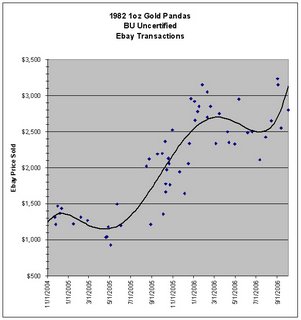
Prices of 1982 1oz Pandas have nearly tripled from about $1000 in late 1994 to about $3000 today. The orignal mintage of this coin was 15,971 coins.
Interestingly, the 1982 1/2oz panda, with a lower mintage of only 13,339, has not yet moved up more than 30%, making it a very good value.
Low mintage, early gold 1983 and 1984 pandas are also still at reasonable prices.

Prices of 1982 1oz Pandas have nearly tripled from about $1000 in late 1994 to about $3000 today. The orignal mintage of this coin was 15,971 coins.
Interestingly, the 1982 1/2oz panda, with a lower mintage of only 13,339, has not yet moved up more than 30%, making it a very good value.
Low mintage, early gold 1983 and 1984 pandas are also still at reasonable prices.
Monday, October 02, 2006
The Market for Modern Chinese Panda Coins
China began issuing the gold Panda coin series in 1982. Silver Pandas were minted beginning in 1983. These coins were very popular due to thier beauty and bullion purity, and many were used for jewelry.
Mintages for the early dates were very low, but until recently, prices did not reflect the rarity of these attractive coins. However, withing the last year, the price of the 1st year issue coins has tripled.
Factors driving demand for Pandas
Mintages for the early dates were very low, but until recently, prices did not reflect the rarity of these attractive coins. However, withing the last year, the price of the 1st year issue coins has tripled.
Factors driving demand for Pandas
- the bull market in coins and precious metals
- in 2006 China legalized the ownership of gold by chinese citizens
- growing middle and upper class of 300 million people now have the financial means to buy gold and silver
Subscribe to:
Posts (Atom)